If you own a building, you have been asked some version of the question a hundred times: how is the building doing? A lender asks it. A partner asks it. You ask it yourself on the drive past the property. And the honest answer is usually built from the last thing that happened: the invoice that landed Tuesday, the tenant who called about the heat, the vendor who said the rooftop unit "should be fine for now." That is not a picture of the building. It is a picture of last week.
Owners say this is the part that wears on them. In Buildium's 2026 Rental Owners' Survey of 300 owners, 46% named maintenance their single biggest stressor, ahead of vacancy and rent. Asked what they wanted more of, 57% said communication and 34% said transparency, and 84% said they want a say before a large repair is approved. None of that is a complaint about the work. It is a request to see it.
This guide lays out what building health at a glance actually means: the five signals that tell you whether a building is getting better or worse, where each one lives today, and how to read them in a few minutes a month. It works the same whether you manage the building yourself or work with a property management company. The signals do not change. Only who keeps the record does.
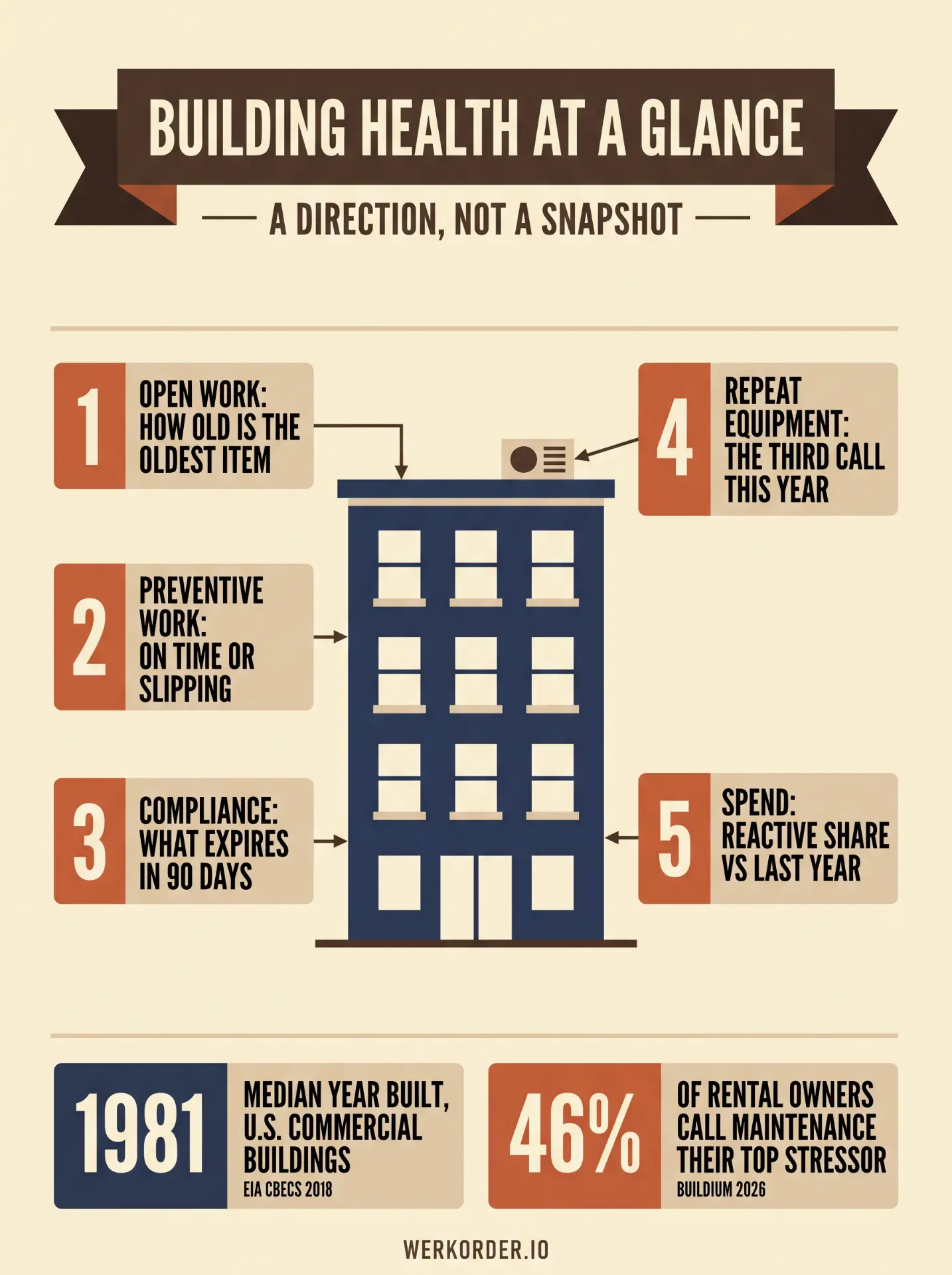
Building health is a direction, not a snapshot
Most of what owners see about a building is a snapshot. A property condition assessment when you buy or refinance. An insurance inspection. A year-end summary of what was spent. Each is useful, and each is out of date the week after it is written.
Building health is the direction the building is moving between those snapshots. A building can pass an inspection and still be sliding: preventive work slipping a few weeks at a time, the same equipment generating its third service call of the year, a certificate that will expire in the spring with nobody assigned to it. None of those shows up on an invoice until it becomes one.
The stock most owners hold is old enough that direction matters. The U.S. Energy Information Administration's 2018 Commercial Buildings Energy Consumption Survey counted 5.9 million commercial buildings in the country, and the median year of construction was 1981. A building past forty does not fail on a schedule. It tells you it is going to fail, in small ways, months ahead. The question is whether anyone is in a position to notice.
The five signals worth checking
You do not need forty rows of work orders to know how a building is doing. You need five signals, read the same way every month.
1. Open work, and how old it is. Not how many work orders closed last month, but what is still open and for how long. Ten open items that are all under a week old describe a busy building. Three items open for sixty days describe a building where something is stuck.
2. Preventive work, on time or slipping. Every building has a schedule of things that should happen whether or not anything is broken: filter changes, roof and drain checks, boiler and cooling tower service, sealant and envelope inspections. The signal is not whether the schedule exists. It is whether this month's tasks closed when they were due.
3. Compliance items, current or expiring. Fire alarm and sprinkler inspections, elevator certificates, backflow tests, boiler certificates, whatever your jurisdiction and your insurer require. The signal is a date: what expires in the next ninety days, and who has it.
4. Repeat equipment. The rooftop unit on its third emergency call this year, the pump that keeps tripping, the roof section that leaks every heavy rain. Repeat calls on one asset are the clearest early sign that a repair is turning into a replacement.
5. Spend against plan. Not the total, but the shape: is maintenance spend tracking what you budgeted, and is more of it reactive than last year? A rising share of emergency and after-hours work usually means the preventive schedule is losing ground.
Why the preventive signal matters most
If you only had time to watch one of the five, watch the second. Preventive work is the cheapest money in a building, and it is the first thing to slip when a week gets busy.
The U.S. Department of Energy's Operations and Maintenance Best Practices Guide estimates that a preventive maintenance program saves 12% to 18% over a reactive one. Yet in the same EIA survey, regular HVAC maintenance was reported in 60% of commercial buildings, covering 81% of floorspace. The gap between those two numbers tells you the buildings without a regular program skew small, and small buildings are exactly where one owner or one manager is carrying everything at once.
Plant Engineering's maintenance survey still finds some equipment run to failure in 57% of facilities. Sometimes that is a deliberate call. More often it happens one skipped task at a time, and it is invisible until the call comes.
Self-managed or with a manager: same signals, different blind spots
How you see these signals depends on how the building is run, and both setups are common. The 2021 Rental Housing Finance Survey from HUD and the Census Bureau found that about 22% of small rental properties (one to four units) are managed professionally, against 84% of properties with 150 or more units. Many owners do both: they run a few buildings themselves and hand larger ones to a firm.
If you self-manage, the signals live with you: in your phone, your email, a spreadsheet you update when you remember, and your memory of which vendor said what. The risk is not that you do not know your buildings. It is that the record is only as current as the last time you had an hour to sit down with it, and that hour rarely comes in October.
If you work with a property management company, your manager almost certainly tracks most of these signals already. They are the ones closing the work orders, chasing the certificates and calling the vendor back. The gap is that what reaches you is a monthly report built after the fact, often a list of what was done rather than which way the building is moving. The work is happening. You just see it a month late and in a format that makes the trend hard to read.
In both cases the problem is the same: the information exists, but it does not sit in one place you can look at in five minutes.
The hard part was never knowing what to look for
Most owners reading this could have written the list of five signals themselves. You know a building with old open work orders is a building with a problem. You know repeat calls on one unit mean replacement is coming. The hard part is not knowing what matters. It is that the facts behind each signal are scattered across a work order system, a compliance binder, vendor emails and someone's memory, and pulling them together for every building, every month, is a job nobody has time to do well.
So owners fall back on the snapshot that is easiest to get: the latest invoice. And the invoice is the worst place to judge a building, because by the time a repair shows up on one, the decision that could have prevented it was made months ago. Owners are not asking for more reports. They are asking for a view that stays current without anyone rebuilding it.
Seeing every building at a glance with WerkOrder
That is exactly the gap WerkOrder was built to close. Owners, property managers and service companies work in one system, so the five signals come from the same record the work happens in instead of a report assembled afterward. Tenant emails become dispatched work orders automatically, so open work is logged the moment it arrives and its age is always visible. The platform's AI builds each building's inspection and preventive maintenance schedule from a walkthrough of the systems the building actually has, and every task shows on time or overdue. Compliance items carry their expiration dates, and repeat calls roll up to the equipment they came from.
All of it feeds a Building Health Score for each building: one number that moves up when preventive work and inspections close on time and work orders resolve within their targets, and down when tasks slip, certificates lapse or the same equipment keeps generating reactive work. Whether you self-manage or work with a property management company, you see the health of every building at a glance, with the open items behind each number one click away. Your manager keeps doing the work. You finally get to see it.
Ready to modernize your maintenance?
Join property teams using AI to cut costs and resolve issues faster.