What a Building Health Score Is, and Why Owners Trust It More Than Your Monthly Report (2026)
Owners are not saying the work is bad. They are saying they cannot see it. A building health score turns your maintenance record into proof they can read.
If you manage commercial property for someone else, there is a question you answer every month and never quite finish answering: how is the building doing? The owner asks it on a call, in a quarterly review, or in a two-line email after a big invoice lands. You answer with a spreadsheet of closed work orders, a vendor summary, and a sentence that starts with "overall." And you both know the sentence is doing most of the work.
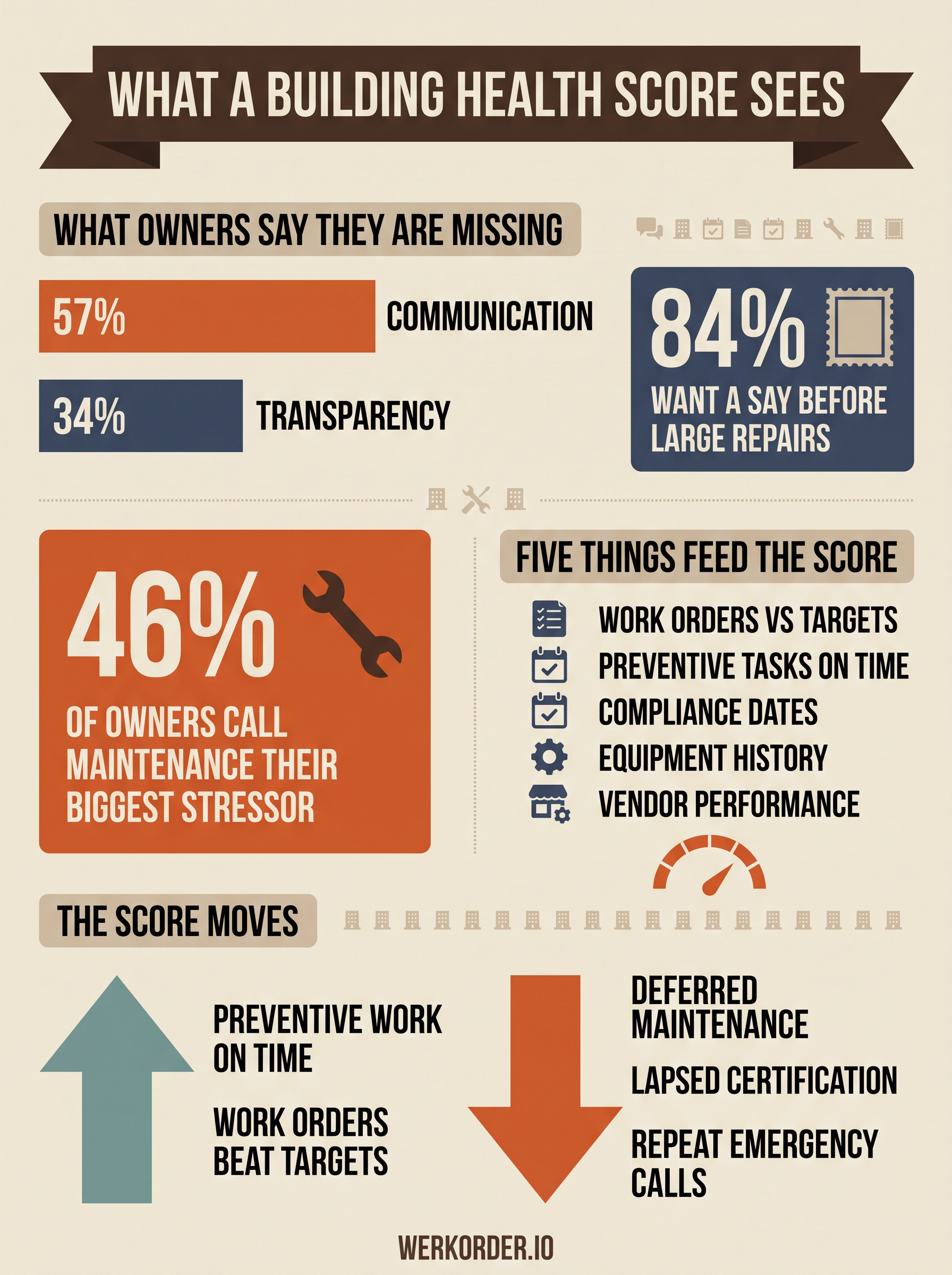
The numbers on that gap are consistent. In Buildium's 2026 Rental Owners' Survey of 300 owners, 46% called maintenance their single biggest stressor, ahead of vacancy and rent. Asked what they wanted more of from their property manager, 57% said communication and 34% said transparency. 84% want to weigh in before a large repair is approved. Owners are not saying the work is bad. They are saying they cannot see it.
This post explains what a building health score is, what feeds it, how it differs from the maintenance report you already send, and why a single number that an owner can read in three seconds does more for the relationship than forty rows they will never open. It is written for the manager, because the score is only as good as the operation behind it.
A building health score, defined
A building health score is a single rolling number that summarizes the maintenance condition of one building, calculated from the work that actually happened in it. It moves up when preventive tasks and inspections complete on time and work orders close within their resolution targets. It moves down when maintenance is deferred, certifications lapse, the same equipment keeps generating reactive work, or vendors miss their windows. Put buildings side by side and the score becomes a portfolio view: which properties are holding, which are drifting, and which one needs a conversation before it becomes a claim.
Two things the score is not. It is not an appraisal or a capital condition assessment; those are point-in-time snapshots by a third party, expensive and quickly stale. And it is not a satisfaction rating. Tenants can be perfectly happy in a building whose boiler is one winter from failure. The score measures the operation, not the mood.
What feeds the score
Every input is something a well-run maintenance operation already produces. Completed work orders, with time to resolution against the priority they were given. Preventive maintenance and inspection tasks, and whether they closed on schedule or slipped. Compliance items: fire, elevator, backflow, boiler, whatever your jurisdiction and your insurer require, with expiration dates that either got beaten or got missed. Equipment history, so a rooftop unit on its third emergency call in a quarter counts against the building instead of hiding across three separate tickets. And vendor performance, because a building serviced by contractors who show up late and close jobs incomplete is less healthy than the invoice total suggests.
None of that is new data. What is new is that it rolls up. Today those signals live in a work order system, a compliance binder, a vendor's email thread, and your memory. The score is what you get when they all land in one place and are read together.
Why the score beats the monthly report
The monthly maintenance report answers the question "what did you do?" The score answers the question the owner is actually asking, which is "is my building getting better or worse?" Those are different questions, and the report is a poor tool for the second one. A report with thirty closed work orders can describe a building that is being run into the ground reactively. A report with eight can describe a building where the preventive schedule quietly prevented the other twenty-two.
Owners feel this difference even when they cannot name it. In the same Buildium survey, 84% of owners said they want to approve large repairs before they happen. That is not a control problem. It is a visibility problem: when the only signal an owner gets is the invoice, the invoice becomes the place they try to exercise judgment. Give them a trend line that was already moving before the repair, and the repair reads as the plan working rather than the plan failing.
Owner reporting: the score as your standing answer
The practical change is that "how is the building doing?" stops being a monthly essay and becomes a standing answer the owner can check without calling you. A score with a direction (up over the last quarter, flat, down since June) plus the three items behind the direction is more information than most owner reports carry and takes a tenth of the time to absorb.
It also changes the tone of the difficult conversations. A building trending down for two quarters, with deferred roof work and a lapsed inspection behind it, is a case for capital that makes itself. You are no longer the manager asking for money; you are the manager who saw it coming and said so on the record. The Buildium respondents who named communication as the thing they were missing were describing the opposite experience: surprises, explained after the fact.
What a low score is telling you
Managers sometimes resist scoring because a low number feels like a grade on them. Read it the other way. A falling score is the earliest, cheapest warning you will get that a building is sliding toward the run-to-failure pattern that Plant Engineering's maintenance survey still finds in 57% of facilities, and that the U.S. Department of Energy says costs up to 40% more than getting ahead of it. Every score that drops is a repair you get to schedule instead of absorb.
The pattern to watch is not the level but the shape. A building that scores lower than its neighbors because it is older is a fact. A building whose score has fallen three months running while its work order count went up is a building generating reactive work faster than you can close it. That is the one to walk this week.
The hard part was never knowing this
Every property manager reading this already runs some version of it in their head. You know which building is the problem child. You know the boiler that worries you and the vendor you would not use again. The hard part is that the knowledge lives in you, and the owner cannot see inside your head, so they see the invoice instead. The report you send is your attempt to externalize what you know, once a month, from memory, on a Friday, for eight buildings at once. It is not that managers lack the information. It is that the information never becomes a shared, standing artifact the owner can trust without trusting you personally on every line.
That's exactly the gap Werkorder was built to close. Its AI turns a tenant email into a structured work order automatically and matches it to the right vendor by trade, location, and availability, so the work that feeds the score gets tracked without anyone retyping it. It builds each building's preventive maintenance and inspection schedule, so on-time completion is the default rather than a heroic effort. And every closed work order, inspection, and vendor result rolls into the Building Health Score, which flags declining properties early and gives owners a portfolio view of maintenance spend by building, trade, and vendor, work order history against resolution benchmarks, and vendor scorecards. The owner gets a standing answer. You get to stop writing the essay.
Ready to modernize your maintenance?
Join property teams using AI to cut costs and resolve issues faster.