If you own a commercial or multifamily building, you have deferred maintenance. Every owner does. A roof section gets patched for one more year, a cooling tower "has another season in it," the parking lot gets sealed next spring instead of this one. Each of those decisions is reasonable on the day it is made. The trouble is that deferral is not one decision. It is a balance that keeps growing in the background, and most owners never see the total until a lender's inspector, an insurance adjuster or a failed compressor reads it to them.
The largest property owner in the country shows how fast that balance compounds. The U.S. Government Accountability Office reported in April 2025 that the federal deferred maintenance and repair backlog "more than doubled, from $171 billion to $370 billion, between fiscal years 2017 and 2024," and warned that buildings left that way "need premature replacement, which can be significantly more expensive than if maintenance and repairs were done when originally scheduled." Private owners feel the same weight. In Buildium's 2026 Rental Owners' Survey of 300 owners, 46% called maintenance their single biggest stressor, ahead of vacancy and rent.
This post puts numbers on the cost of deferred maintenance: where the money goes when a repair waits, which costs arrive on a schedule and which arrive all at once, and how to turn deferral into a decision you can see instead of a balance you discover. Deferring a repair is sometimes the right call. Deferring it without a record is never cheap.
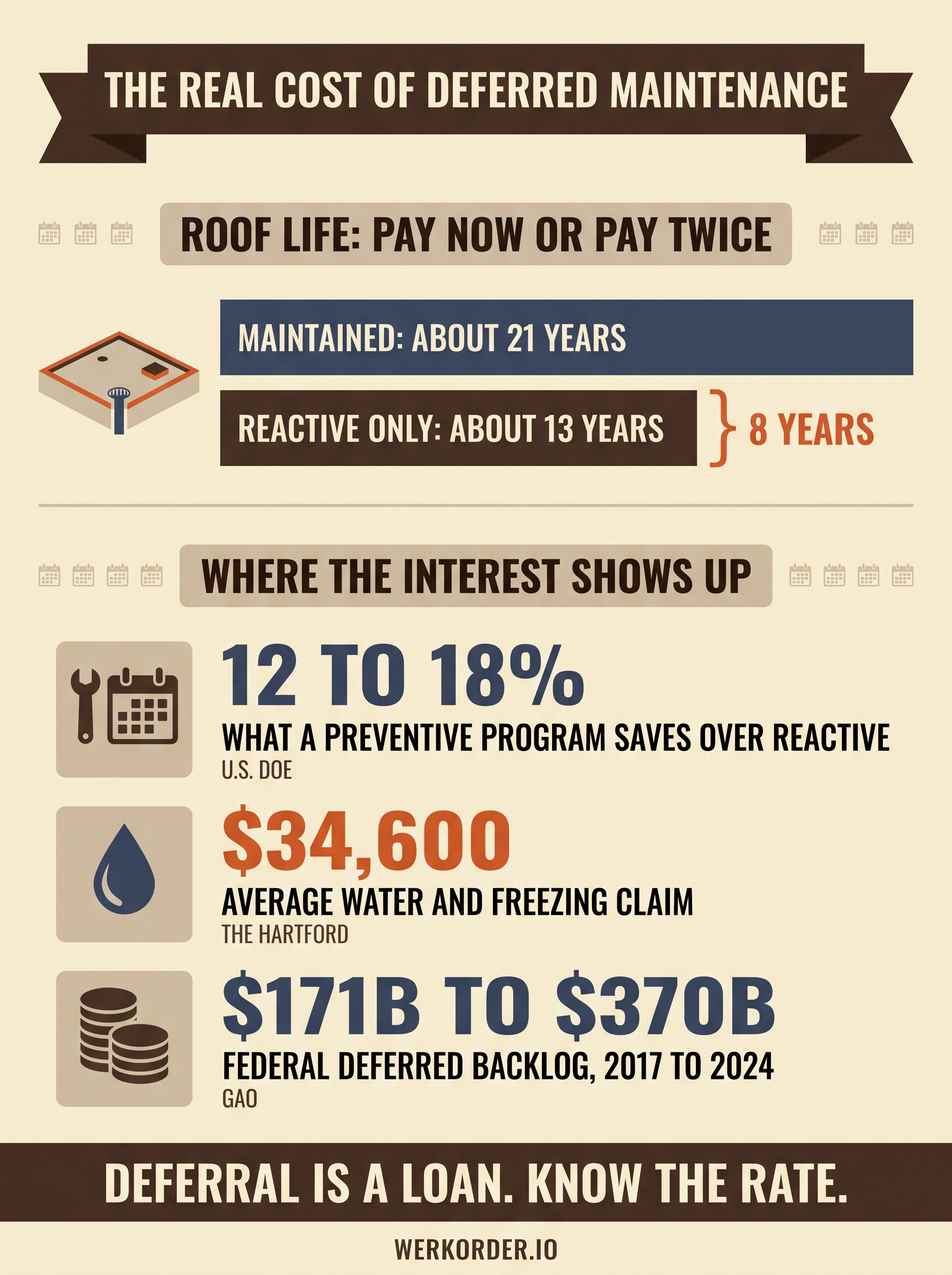
Deferred maintenance is a loan, and the interest is not on any statement
Every deferred repair works like borrowing. You keep the cash this year, and you pay it back later with interest. The difference from a real loan is that nobody prints the rate.
The U.S. Department of Energy's Operations and Maintenance Best Practices Guide puts a number on the spread. It estimates that a preventive maintenance program saves 12% to 18% over a reactive one, and the Department has found that a predictive approach saves up to 40% over reactive maintenance. Those percentages come from the same work done at different times. The parts are the same. What changes is everything around them: the after-hours rate for the emergency call, the expedited shipping on a compressor nobody stocked, the ceiling tiles and carpet under the leak, the tenant credit for a suite that was too hot to use for two days.
That is the interest. It never appears as a line called "cost of waiting." It shows up spread across emergency invoices, insurance deductibles and concessions, in a different month and often a different budget year from the decision that caused it. Which is exactly why it is so easy to underestimate.
Roofs: the clearest case for paying now
If you want one system that makes the math visible, look up. Industry research summarized in Building Enclosure, drawing on manufacturer and APPA facilities data, found that roofs on a proactive maintenance program reach roughly 21 years of service life, against roughly 13 years for roofs that only get attention when they leak. Same membrane, same weather. Eight years of difference comes almost entirely from small, scheduled work: clearing drains, resealing flashing and penetrations, fixing a blister before it becomes a split.
Eight years is not a rounding error on a roof. On a building with a large flat roof, it is the difference between replacing it once in your hold period and replacing it twice.
The same article makes a point every owner should keep in mind: a roof can leak for days, weeks or months before anyone notices it inside the building. By the time a stain shows up on a ceiling tile, the insulation under the membrane may already be wet, and wet insulation turns a repair into a tear-off. A deferred roof repair does not sit still. It spreads.
Water: where a deferred repair becomes a claim
Most of the expensive surprises in a building involve water, and most of them start as a small item somebody meant to get to. A valve that weeps. A sealant joint that has pulled away from the window frame. A sump pump that runs longer than it used to.
The Hartford found that water and freezing damage accounts for roughly 22% of small-business claims, averaging $34,600 per claim. A Philadelphia Insurance study of 433 burst-pipe losses put the average claim at $27,000, with sprinkler systems behind roughly half of them. Those are the losses that made it to a claim. The ones that stayed under the deductible came straight out of operating income.
There is a second reason water damage hurts owners twice. A sudden burst is usually the kind of event a property policy is written for. A slow leak from a component everyone knew was failing can sit much closer to the wear-and-tear language in the same policy. It is worth reading those exclusions now, with your broker, rather than the week after the ceiling comes down.
The balance comes due at the worst moment
Deferred maintenance has a habit of being discovered when you have the least room to negotiate: at refinance, at sale, or at a lender inspection.
Lenders do not leave it to chance. Fannie Mae's instructions for a multifamily Property Condition Assessment have a category called "Deferred Maintenance Items," defined as non-recurring capital items, systems, components or equipment that are approaching, have reached or have exceeded their estimated useful life. A buyer's inspector looks for the same things. Whatever was deferred becomes a number in someone else's report, priced by someone else, at the moment you most want the building to look its best.
That is the quiet cost of deferral without a record. The work was always going to cost money. The question is whether you pay for it on your schedule, at your price, or on the schedule of the person across the table.
The real problem is not deferral. It is that deferral is invisible.
Most owners reading this have no interest in spending every dollar the moment a system shows wear. Capital is finite, and some repairs should wait. The hard part is not deciding to defer. It is that the decision usually disappears the moment it is made.
Think about how a deferral actually happens. Your property manager or your vendor flags the item, often more than once. There is a reasonable conversation about budget and timing. Everyone agrees it can wait until spring. And then the record of that agreement lives in an email thread from March, a note in a vendor's proposal, and somebody's memory. Nobody set a date to look at it again. Nobody wrote down what the failure would cost compared with the repair. A year later the item is still there, larger, and the people who made the call cannot find where they made it.
Owners say this is what they are missing. In the same Buildium survey, asked what they wanted more of, 57% of owners said communication and 34% said transparency, and 84% said they want to weigh in before a large repair is approved. Owners are not asking for fewer deferrals. They are asking to see them. A deferral with an item, a date, a reason, today's price, the price of failure and a next review date is a business decision. A deferral without those is a liability nobody owns.
Making deferral visible with WerkOrder
That is exactly the gap WerkOrder was built to close. Owners, property managers and service companies work in one system, so a repair that gets put off stays on the record with its reasons attached instead of vanishing into an inbox. The platform's AI builds each building's inspection and preventive maintenance schedule from a walkthrough of the systems it actually has, so nothing gets deferred simply because nobody remembered it was due. Tenant emails become dispatched work orders automatically, so small problems are logged when they are still small.
And every building gets a Building Health Score that moves down when preventive tasks slip, inspections lapse or the same equipment keeps generating reactive work. For an owner, that turns the deferred balance into something you can watch: one number per building, trending up or down, with the open items behind it. Whether you self-manage or work with a property management company, you see the health of every building at a glance, and the conversation about what to fix this year starts from the same facts on both sides of the table.
Ready to modernize your maintenance?
Join property teams using AI to cut costs and resolve issues faster.