The Fall Commercial Building Maintenance Checklist for Kansas City (2026)
The fall preventive maintenance checklist for Kansas City commercial buildings: heating, roofs, freeze points, inspections, and grounds, in the order winter tests them.
Kansas City doesn't give you a long runway into winter. One week in October the Plaza is patio weather, and the next a front rolls down I-35 and your maintenance phone starts ringing before sunrise. Fall is the last season where every problem in your buildings is still cheap. The boiler that needs a part, the roof drain packed with leaves, the vacant suite nobody has walked in a month: right now they're line items. By January they're claims.
The numbers on waiting are blunt. The Hartford found that water and freezing damage now accounts for roughly 22% of small-business claims, averaging $34,600 per claim, and a Philadelphia Insurance study of 433 burst-pipe losses put the average frozen-pipe claim at $27,000. Industry estimates consistently peg reactive maintenance at 3 to 5 times the cost of doing the same work preventively. Fall is when you choose which side of that multiple you're on.
This guide is a working commercial building maintenance checklist for the fall season, organized by the systems that fail first in a Kansas City winter: heating, roofs and drainage, envelope and plumbing, life safety, and grounds. Work through it building by building between now and the first hard freeze, and you go into winter with proof instead of hope.
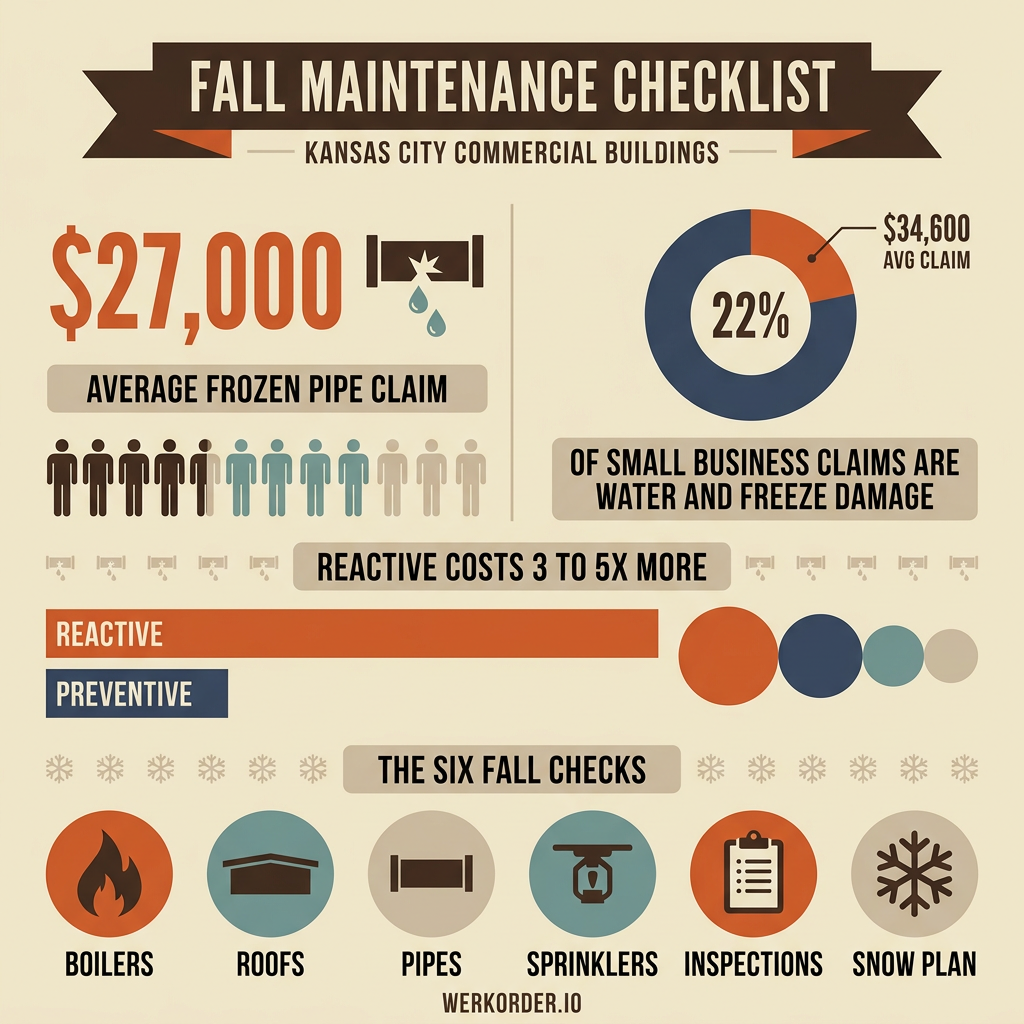
The fall checklist at a glance
- Service every boiler and heating system before the first cold snap
- Clear roof drains, scuppers, and gutters; inspect flashing and seams
- Insulate exposed pipes and set minimum temperatures in vacant spaces
- Test freeze protection on sprinkler systems in unheated areas
- Complete the fall cluster of life-safety inspections and document them
- Shut down irrigation, drain exterior lines, and stage snow and ice contracts
The rest of this post turns each line into the specific tasks your team or your vendors should be completing, roughly in the order the weather will test them.
Heating and boilers: service before the first cold snap, not after
Every HVAC contractor in the metro is slammed the week of the first freeze. Book fall service now and you get a technician who has time to do it right. Combustion check, flue draft, low-water cutoff, relief valve, and a bled distribution loop so heat actually reaches the top floor. Confirm the boiler's annual inspection certificate is current while the technician is standing next to it; Missouri and Kansas jurisdictions both expect one, and January is a bad month to discover it lapsed.
For rooftop units and split systems, fall is changeover season. Filters, belts, heat exchangers, and a test fire on heating mode before tenants need it. A unit that short-cycles in October is a comfort complaint. The same unit failing in January is an emergency call at emergency rates.
Roofs and drainage: clear them before the leaves finish falling
Flat roofs carry winter's hidden load. Ponding water that freezes, refreezes, and works into every seam. The fall tasks are simple and cheap: clear drains, scuppers, and gutters after the leaves come down, inspect flashing and seams around rooftop units, and photograph baseline condition now so you can re-check after every ice event with something to compare against. Document as you go. If a membrane fails in February, the owner's first question is when the roof was last inspected, and "November, with photos" is the answer that keeps the conversation short.
Building envelope and plumbing: find the freeze points now
The freeze points in a commercial building are predictable: exposed lines in attics, crawlspaces, and exterior walls, and any plumbing in a space where somebody turned the heat down to save on the gas bill. Insulate what's exposed. Hold vacant suites at a minimum temperature instead of shutting heat off, because the few dollars saved on gas is exactly how a $27,000 pipe claim starts. Walk vacant units on a schedule through winter, not just when a showing comes up.
Give sprinkler lines in unheated areas particular attention. Dry systems need their low points drained, and wet systems in marginal spaces need verified heat. Know where every main shutoff is, and make sure the person on call in January knows too.
Life safety and compliance: the fall inspection cluster
Fall stacks up inspection deadlines: fire alarm and sprinkler tests, extinguisher checks, emergency lighting, backflow certifications coming due before year-end. Knock them out in one coordinated pass per building rather than fielding them one certified letter at a time. Every completed inspection goes in the file with a date and a vendor name. Compliance you can't document is compliance you don't have.
Grounds and exterior: the last mow to the first freeze
Shut down and drain irrigation before the first hard freeze. Disconnect hoses, insulate hose bibs, and drain exterior lines. Walk parking lots and sidewalks now, because the crack that holds water in November is the pothole and the slip-and-fall exposure of February. And get snow and ice contracts signed in the fall, when you can still negotiate. Calling for a plow vendor during the season's first storm puts you at the back of a very long line.
The list is the easy part
Here's the part every property manager already knows in their gut: none of this is a knowledge problem. You knew the boiler needed fall service and the vacant suite needed heat before you read this. The losses don't come from ignorance. They come from follow-through, from a few dozen small seasonal tasks spread across a portfolio that have to be scheduled, assigned, completed, and verified, where the one that slips is invisible until a ceiling comes down. The checklist isn't the hard part. Running it across every building, every year, without missing one is the actual job.
That's exactly the gap Werkorder was built to close. Its AI builds the preventive maintenance and inspection schedule for each building based on its systems and local requirements, so the fall tasks surface on time instead of living in a spreadsheet. When a tenant reports a problem, the email becomes a work order automatically, whether the inbox is connected to Werkorder or the message is simply forwarded in, and the platform matches the right vendor to the job by trade, location, and availability. Every completed task rolls up into a Building Health Score, which means the owner asking how the building is prepared for winter gets an answer with evidence behind it.
Ready to modernize your maintenance?
Join property teams using AI to cut costs and resolve issues faster.