Property Maintenance Contracts: How Service Companies Get Matched to the Right Jobs (2026)
65% of commercial contractors say repeat customers drive their business. The five things a property manager checks before dispatching a service company.
If you run a service company, you already know the property work you want. It is the recurring kind: the building that calls you for the rooftop units every spring, the portfolio that puts you on a planned maintenance agreement, the manager who texts you first when the boiler acts up because you fixed it right last time. What is harder to see is how that work gets decided. Somewhere between a tenant's email and a dispatched job, a property manager makes a fast call about who can handle it, in this building, this week, without a second trip. Your company is either in that call or it is not.
The numbers say much of that work is won before any bid. In ServiceTitan's 2025 Commercial Service Market Report, a survey of more than 1,000 commercial contractor owners and executives run with Thrive Analytics, "repeat customers (65%) and word-of-mouth referrals (60%) remain the primary drivers of business volume." The same report found that 63% of contractors secure more than half of their customer base through planned maintenance agreements. Recurring work is not a side benefit of good service. It is the business.
That is the good news and the hard news at once. If repeat work and referrals carry the load, then getting matched to new property maintenance contracts depends less on how loudly you market and more on how easy you are to choose. This guide walks through the five things a property manager is actually checking when they pick a service company, and what you can do about each one.
Trade fit: say exactly what you do, by system and building type
A property manager dispatching a job is not looking for "a contractor." They are looking for someone who services this make of rooftop unit, or clears this kind of main line, or tests this fire alarm panel, in this kind of building. A shop that lists "HVAC, plumbing, electrical" gets weighed against everyone else who lists the same three words.
The service companies that get matched well describe their work the way a manager would search for it: the systems they service, the equipment brands they know, and the building types they work in most (multifamily, office, retail, light industrial). If you do commercial refrigeration and you also handle boiler changeovers in older buildings, say both. Specific beats broad, because the manager's question is always specific.
Building type matters more than most shops assume. A crew that knows how a 1980s mid-rise mechanical room is laid out finishes faster and causes fewer tenant complaints than a crew seeing one for the first time. If that experience is real, it belongs in the description of your company, not only in your head.
Certifications: current, per technician, and easy to prove
Certifications are the part of the decision nobody wants to think about until something goes wrong. Under the Clean Air Act, any technician who services equipment containing refrigerant needs EPA Section 608 certification. Many property owners and their insurers also expect OSHA safety training, fire protection credentials such as NICET, and current trade licenses before a crew sets foot on the roof.
The catch is that certifications belong to people, not companies. Your company may be fully qualified on paper while the tech you planned to send has a card that lapsed last month. Managers who have been burned by that once start asking for proof every time, and every request for proof is friction.
The shops that make this easy keep a simple record per technician: which certifications, which numbers, which expiration dates, and who is up for renewal in the next ninety days. That record does two jobs. It keeps you from sending an unqualified tech, and it lets you answer a manager's "who's certified for this?" in one message instead of three.
Service area and availability: be honest about your radius and your capacity
Every company wants more work until it has to staff it. In the same ServiceTitan report, 52% of commercial contractors named a skilled labor shortage as their top headwind. The U.S. Bureau of Labor Statistics projects about 40,600 openings a year for HVAC mechanics and installers through 2035, and Associated Builders and Contractors estimates the construction industry needs to attract 349,000 net new workers in 2026 alone. Capacity is the constraint for almost everyone.
That is exactly why honesty about your service area and availability wins jobs. A property manager would rather dispatch the company that says "we can be there Thursday morning" than the one that says yes to everything and shows up Monday. Draw your service area where your trucks actually go. Block the weeks you are already committed. Say no to the job you cannot staff.
It feels like turning down work. In practice it is how you become the company a manager trusts to answer straight, and that trust is what turns a one-off call into the next maintenance agreement.
Arriving informed: the first visit decides the second
The fastest way to lose a property client is the second trip. A tech arrives, finds the issue is not what the tenant described, does not have the part, cannot get into the mechanical room, and leaves with a "we'll come back." The manager now has an unhappy tenant, a second visit on the invoice, and a quiet note about who to call next time.
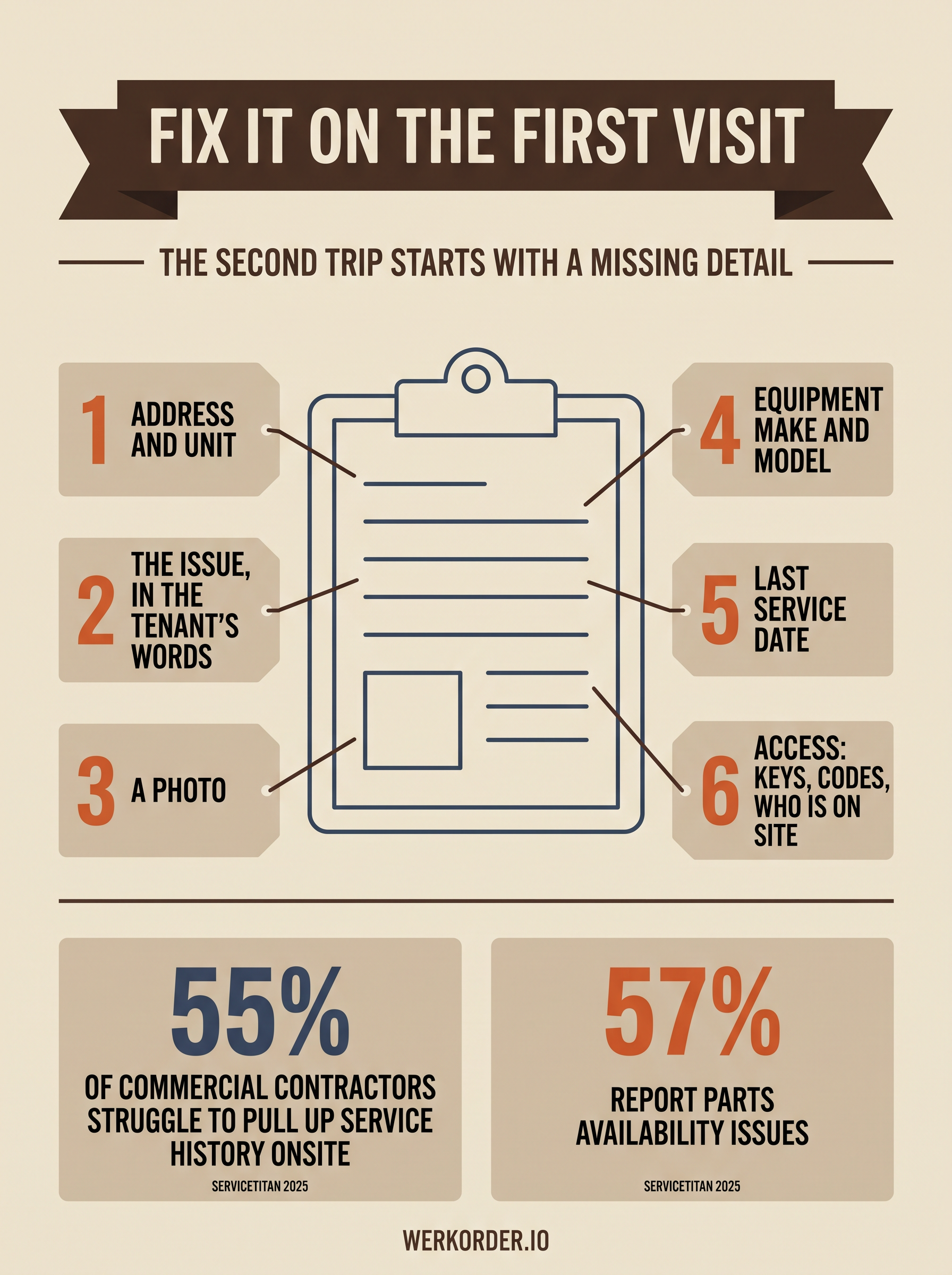
Most second trips start with missing information, not missing skill. ServiceTitan's 2025 report found that 55% of commercial contractors struggle to retrieve service and repair history onsite, 57% report issues with parts availability, and 70% lack fast access to warranty and service agreement data. None of that is a skill gap. It is a hand-off gap.
The service companies with the best first-visit record ask for the same things before every dispatch: the address and unit, the issue in the tenant's words, a photo if one exists, the equipment make and model, the last service date, and how to get access. When that information arrives with the job, the right tech rolls with the right part. When it does not, ask for it before the truck leaves. A two-minute question saves a two-hour return.
Closing the loop: the record you leave is the pitch for the next job
When a job is done, the property manager has to report it somewhere: to the owner, to the tenant, to the file for the next inspection. The service company that makes that report easy gets remembered.
A good closeout takes five minutes. What you found. What you did. Parts used and their model numbers. Before and after photos. Anything you saw that will need attention soon, flagged plainly with a rough timeline. That last item matters most. ServiceTitan found that 75% of contractors with maintenance agreements get more than 20% of additional revenue from pull-through work, the repairs they spot during scheduled visits. A clear closeout note is how that next repair gets approved, because it gives the manager something they can forward to the owner without rewriting it.
Over a year, those closeouts become your track record: response times, completion times, first-visit fixes, follow-up work found and done. That record is what a manager is really checking when they decide whether you get the next building.
The real problem isn't marketing. It's being legible.
Most service company owners reading this already do good work. The trade fit is real, the techs are certified, the crews show up. The hard part is that almost none of it is visible to the person deciding who gets the job. The certifications live in a binder in the office. The service history lives in a tech's phone. The great closeout from last March lives in a text thread with a manager who has since moved to another portfolio.
So the decision defaults to memory. The manager calls whoever they called last time, or whoever a colleague mentioned, because that is the only information they can reach at 4:45 on a Friday with an open work order in front of them. Good shops lose matches they would have won, not because they were worse, but because they were harder to see.
That is the gap Werkorder was built to close. Service companies join the Werkorder marketplace free and build a profile around the facts a manager is actually checking: trades, certifications, building type experience, service area and availability. When a property manager creates a work order, Werkorder's AI recommends the service companies that match that job by trade, certification, proximity and building experience. Per-technician certification tracking warns you before a card expires and only sends jobs to techs who are qualified for them. Every dispatched job arrives with the address, unit, issue description, photos, equipment details and access instructions before you roll, and every completed job, with its ratings and completion times, builds the record that decides how often you are recommended next. Get dispatched the right jobs, communicate in one place, and win more property clients.
The companies that keep property clients for years are not always the biggest shops in town. They are the ones that are easiest to choose, and easiest to choose again.
Ready to get matched to the right jobs?
Join the property maintenance marketplace free and build a profile that works while your crews do.