If you manage commercial or multifamily property, your maintenance operation starts in a place that was never designed for it: your inbox. A tenant writes "the unit is freezing again" at 7:04 in the morning. A retail manager sends a photo of a ceiling stain with no address in the message. A vendor replies to a three-week-old thread asking which door to use. Every one of those is a work request, and every one of them arrives mixed in with invoices, owner questions, and a newsletter you meant to unsubscribe from.
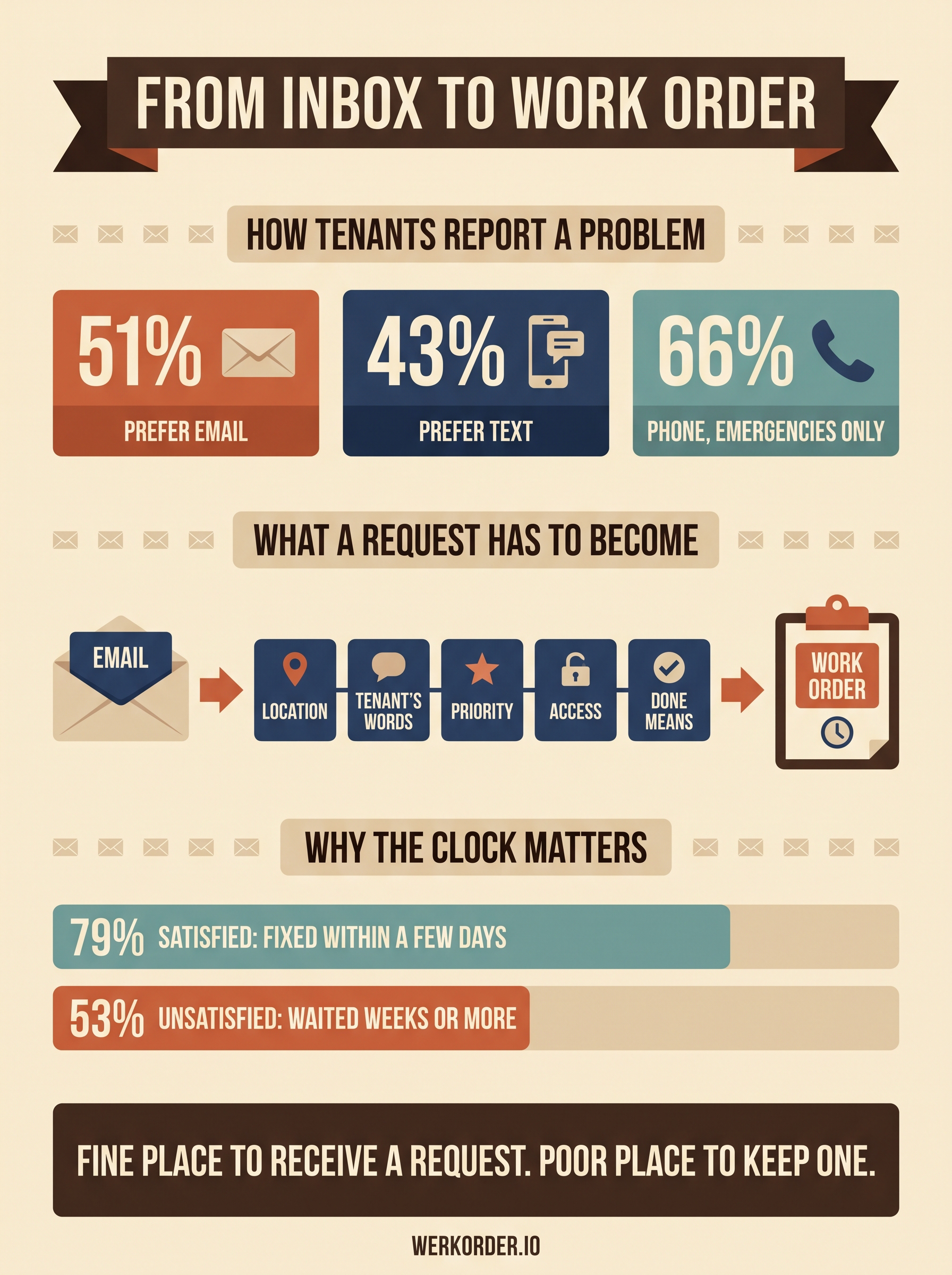
The numbers say this is not going to change. In AppFolio's 2026 Renter Preferences Report, a survey of 3,002 renters, 51% said they prefer email for nonemergency requests and 43% prefer text; only emergencies push them to the phone. The same report found maintenance is the single strongest driver of resident satisfaction, and that 79% of residents who are happy with maintenance had their issues resolved within a few days, while 53% of the unhappy ones waited weeks or more. Tenants will keep writing to you. The question is what happens in the minutes after they do.
This post is about that handoff: how a tenant maintenance request email becomes a tracked, dispatched work order, why the inbox is a fine place to receive a request and a poor place to keep one, and what changes when the step between "received" and "assigned" stops depending on someone retyping it. It is written for the manager, because the manager is the one holding the inbox.
The inbox is a receiving dock, not a warehouse
An inbox does one job well: it accepts anything, from anyone, in any format. That is exactly what you want at the front door. A tenant should not have to learn a portal to report a leak, and most will not. The AppFolio survey found 85% of renters with online portal access were satisfied with their maintenance experience, against 78% without, a real gap but not a large one. Email is still where the majority of requests begin, and forcing people to use another channel mostly means the request arrives late or not at all.
The problem starts when the inbox also becomes the place the request lives. An email has no status. It cannot be assigned. It does not know which building it belongs to, whether it is urgent, or that the same tenant sent a nearly identical message eleven days ago. Once you read it, it is your memory holding the job, not the system. Multiply that by a portfolio and a Friday afternoon, and the requests that get lost are never the loud ones. They are the polite, one-line ones that arrived while you were on site somewhere else.
What a request has to become before anyone can act on it
Between the email and the vendor's truck, five things have to be true. The request has a location: building, floor, suite or unit, not "my office." It has a description in the tenant's own words, because "unit is freezing" and "thermostat reads 68 but feels cold" are different jobs. It has a priority someone actually assigned, so the 7:04 heating call does not queue behind a burned-out bulb. It has access notes: who lets the tech in, when, and what the tenant needs to know. And it has a definition of done, so the work order closes when the problem is solved, not when the visit happens.
None of that is new. It is the anatomy of a complete work order, and every experienced manager builds it in their head within seconds of reading the email. The cost is not knowing what to capture. The cost is capturing it forty times a week, by hand, into a spreadsheet or a work order form, while the inbox keeps filling behind you. A Plant Services study found that only 24.5% of the average maintenance worker's time goes to productive, hands-on work, with nearly 20% of the waste coming from simply waiting for instructions. Instructions that are sitting in someone's inbox, half-transcribed, are the leading cause of that waiting.
Two ways in, one result
There are two honest ways to get a request out of the inbox and into a system without asking tenants to change anything.
The first is to connect the inbox. The mailbox tenants already write to is linked to the maintenance system, and every incoming message is read, classified, and turned into a draft work order automatically: building and unit matched from the sender and the text, urgency inferred from the language, photos attached, duplicates recognized when a tenant replies to an old thread. Nothing changes for the tenant. Nothing changes for the manager's habits either, except that the transcription step disappears.
The second is to forward. When connecting the mailbox is not possible, or when a request arrives at an address that will never be connected (a personal phone, a property's front desk, a vendor's reply), the manager forwards the message to an intake address and the same thing happens: the email becomes a structured work order with the details filled in, ready to assign. Forwarding takes three seconds and works from any device. It is the difference between "I will deal with this when I am back at my desk" and "this is already in the queue."
Both paths end in the same place: a work order that exists in a system, with a status, an owner, and a clock. The manager's judgment is still applied where it matters, confirming the priority, choosing or approving the vendor, deciding whether this is the third time that rooftop unit has come up this quarter. What is gone is the retyping.
Why speed is a system property, not a personality trait
The AppFolio numbers on resolution time are easy to misread. It is tempting to conclude that satisfied residents have faster managers. They do not. They have managers whose requests never sit unassigned. Resolution time is mostly queue time: the hours or days between a request arriving and a qualified person being dispatched to it. The actual repair rarely takes longer for the unhappy tenant than for the happy one.
That reframes the whole problem. You do not fix response time by answering email faster. You fix it by making sure every request becomes a dispatchable work order the moment it arrives, so the queue is visible and nothing waits on a person to notice it. Once the request is in the system, auto-dispatch can match it to a vendor by trade, location, and availability, and the tenant can get an acknowledgment while you are still driving. The 51% who prefer email get to keep emailing. They just stop waiting.
The hard part was never the form
Every property manager reading this already knows what a good work order looks like and already answers tenant email as fast as a human can. The hard part is the volume and the scatter: requests arriving in four channels, at all hours, across a portfolio, each one needing the same five facts pulled out and written down before anyone can act. Doing that well once is easy. Doing it forty times a week, on the tenth open item, at 4:45 on a Friday, is where the polite one-liner slips through.
That's exactly the gap Werkorder was built to close. Connect your inbox or forward the message, and its AI turns the tenant's email into a structured work order automatically: building and unit, the tenant's own description, priority, photos, and access notes, with replies to an existing thread landing on the existing work order instead of creating a duplicate. Auto-dispatch matches the job to the right vendor by trade, location, and availability. And because every request is now a tracked work order from the first minute, every closed one rolls into the Building Health Score, which is how the owner sees that the building is being run well without calling you to ask. The tenant keeps emailing. The request stops living in your head.
Ready to modernize your maintenance?
Join property teams using AI to cut costs and resolve issues faster.