If you manage commercial property anywhere the temperature drops below freezing, winter does not arrive on one day. It arrives as a string of dates, most of them set by someone other than you: a weather service average, a state boiler certificate, a sprinkler standard, the clock change, a city sidewalk ordinance, and the first forecast that says "accumulating." Each one is easy on its own. Together they land inside the same six weeks as budget season, and that is where buildings get caught.
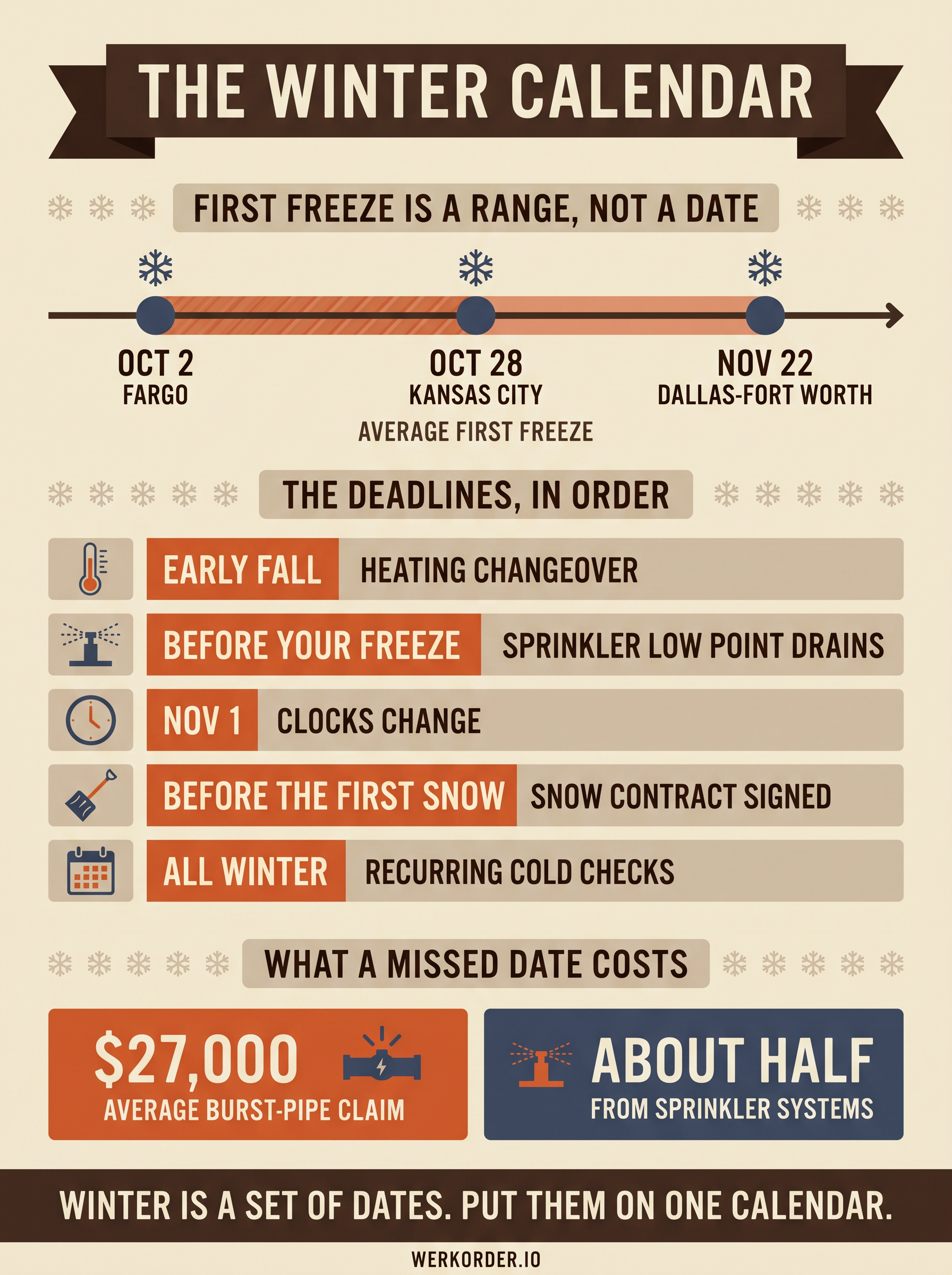
The cost of missing one is not abstract. The Hartford found that water and freezing damage accounts for roughly 22% of small-business claims, averaging $34,600 per claim. A Philadelphia Insurance study of 433 burst-pipe losses put the average claim at $27,000, found that sprinkler systems accounted for roughly half of the claims, and that those sprinkler losses ran about 33% more expensive than domestic water pipe losses. None of those numbers describe exotic failures. They describe dates that came and went.
This guide is not another winterizing checklist. It is the winter readiness calendar: the deadlines in the order they arrive, what each one actually requires, who sets it, and who has to be scheduled before it. The dates differ by region. The order does not. Put your building's dates on a calendar this week and the checklist mostly takes care of itself.
Early fall: heating changeover and the boiler certificate
The first deadline is the one you set yourself, and it is the one most likely to start an argument. In buildings with two-pipe systems, the loop carries either chilled water or hot water, not both. Pick the changeover date too early and the south-facing suites bake through a warm afternoon. Pick it too late and the first cold morning arrives with the boiler still cold and a lobby full of complaints. Decide the date now, write down the outdoor temperature that triggers it, and tell tenants before the day, not after the first cold call.
The boiler itself has a paper deadline behind it. In the large majority of states, a boiler cannot legally run without a current inspection certificate from the state (or, in some cities, the municipal) boiler program. The National Board of Boiler and Pressure Vessel Inspectors keeps a synopsis of every jurisdiction's rules, and the pattern is consistent: power and high-pressure boilers get a certificate inspection every year, and low-pressure steam and hot-water heating boilers every two years, with a few states stretching hot-water supply boilers to three. Texas, Georgia, Virginia, Utah and Missouri all follow that annual-or-biennial pattern; Kansas inspects most objects annually. Penalties for running without a certificate are set state by state and can be steep. Before the changeover, look at the certificate posted on the unit and confirm the expiration date is not sometime in January.
Then book the fall service. The boiler tech you want is booking the same two weeks for every other building in your market, which is why the service call goes on the calendar in September, not the week of the first cold snap.
The first-freeze window: yours is not the national one
The National Centers for Environmental Information publishes median first-freeze dates for the whole country, built on the 1991 to 2020 climate normals, and the spread is wide. Northern and high-elevation locations see their first freeze by early October or earlier; most of California and southern Arizona do not see one until December, if at all. Three National Weather Service offices show how far apart the same deadline can sit: Fargo's average first freeze is October 2, Kansas City's is October 28, and Dallas-Fort Worth's is November 22. Seven weeks separate the first from the last, and a portfolio that spans one metro can have a two-week spread of its own, because suburbs and open ground freeze before the urban core does.
So the deadline is not a national date. It is the date for each building, looked up once (the NWS office for your area publishes it) and written down. Everything that holds standing water outside the heated envelope has to be dealt with before that window opens:
- Sprinkler low point drains. NFPA 25, the standard for inspecting and maintaining sprinkler systems, calls for the auxiliary drains on dry systems to be drained after each operation of the system, before the onset of freezing weather, and as needed after that. "Before the onset" is the deadline, and it means the first days of October in Fargo and the middle of November in Dallas.
- Dry pipe valve rooms. The room that houses the wet side of a dry valve has to stay at 40°F or above. NFPA 25 has the enclosure checked daily during cold weather, or weekly if the room has a low-temperature alarm. Confirm the heater works and the alarm reports to someone who will answer it.
- Irrigation and backflow assemblies. Blow out the lines and drain or insulate the exposed backflow preventers. A cracked assembly is a plumber, a permit and a retest in the middle of winter.
- Hose bibs and exterior faucets. Shut off, drain and cover.
The Philadelphia study named unheated attics as the most frequent cause of burst pipes, followed by concealed spaces between interior and exterior walls. Neither shows up on a walkthrough unless someone goes looking. Add them to the first-freeze walk by name.
November 1: the clock changes, and so do your schedules
Daylight saving time ends at 2 a.m. on Sunday, November 1, everywhere in the country except Arizona and Hawaii. It is a small deadline with a long tail. Parking lot and exterior lighting on mechanical timers is suddenly off by an hour at exactly the time tenants are walking to their cars in the dark. Building automation schedules may or may not adjust themselves. Heating setbacks timed to occupancy can start warming an empty building at 5 a.m. or an occupied one at 7.
Treat November 1 as a scheduled task, not a Monday surprise. Walk the timers, confirm the automation clock, and look at the lot at dusk that Monday.
Before the first snow: the contract, the trigger and the sidewalk
Whether your market averages eight inches a season or eighty, the deadline is not the first flake. It is the day before, when the snow contract needs to be signed, the trigger defined, and the ice melt already on site.
Three things to settle in writing before the first forecast:
- The trigger. At what accumulation does the plow crew come out, and who calls it? "When it snows" is not a trigger.
- The scope. Lots, drives, walks, entrances, loading docks, the fire lane. Anything not named in the contract will not be cleared.
- The sidewalk. Nearly every city puts the public sidewalk on the adjacent owner or occupant, and the clock they set varies. Chicago requires snow that falls overnight to be cleared by 10 a.m. Minneapolis gives four daytime hours after the snow stops. Kansas City says "within a reasonable time." Look up your city's number, and in multi-tenant buildings, make sure the lease says who owns it. The answer belongs somewhere other than a tenant's memory.
Through the end of winter: the recurring deadlines
The last set of deadlines never ends. It repeats. The dry valve room check, daily or weekly. The auxiliary drains after every trip and every hard freeze. The vacant suite thermostat, because an empty unit with the heat set back to nothing is where the pipe freezes first. The inspection after every cold snap, not just the first one.
These are the tasks that make or break the season, because nobody forgets them in October. They get forgotten in the third week of January, on the tenth open work order, when the last cold snap was ten days ago and nothing happened.
The dates are not the hard part
Every property manager reading this knew most of these deadlines existed. The hard part is that they live in six different places. The freeze average lives on a weather service page. The boiler date lives on a certificate bolted to the unit. The sprinkler requirement lives in a standard your fire protection vendor reads and you do not. The snow trigger lives in a contract. The clock change lives in a timer in an electrical room. And the recurring checks live in your head, which is also where the budget, the lease renewals and every tenant's email live this time of year.
A deadline calendar that only exists in your head is a list of things you will remember on the day they fail. Winter readiness is not a knowledge problem. It is a follow-through problem, spread across a portfolio, with the weather setting the timetable.
That is the gap Werkorder was built to close. Its AI builds a preventive maintenance schedule for each building from what the building actually has and where it sits, so the changeover, the certificate check, the low point drains and the recurring cold-weather inspections show up as dated work orders instead of reminders you have to invent. When a tenant emails that the suite is freezing, that email becomes a dispatched work order with the right vendor attached, not a flag in your inbox. And every completed task rolls into the building's Building Health Score, so when an owner asks whether the building is ready for winter, the answer is already on the page.
Ready to modernize your maintenance?
Join property teams using AI to cut costs and resolve issues faster.