If you manage commercial property, your entire day runs on work orders, whether you call them that or not. The tenant email about a leaking ceiling, the note from a walkthrough about a failing exhaust fan, the reminder that the backflow test is due: every one of them either becomes a tracked piece of work or becomes a problem you rediscover later, at a worse time and a higher price.
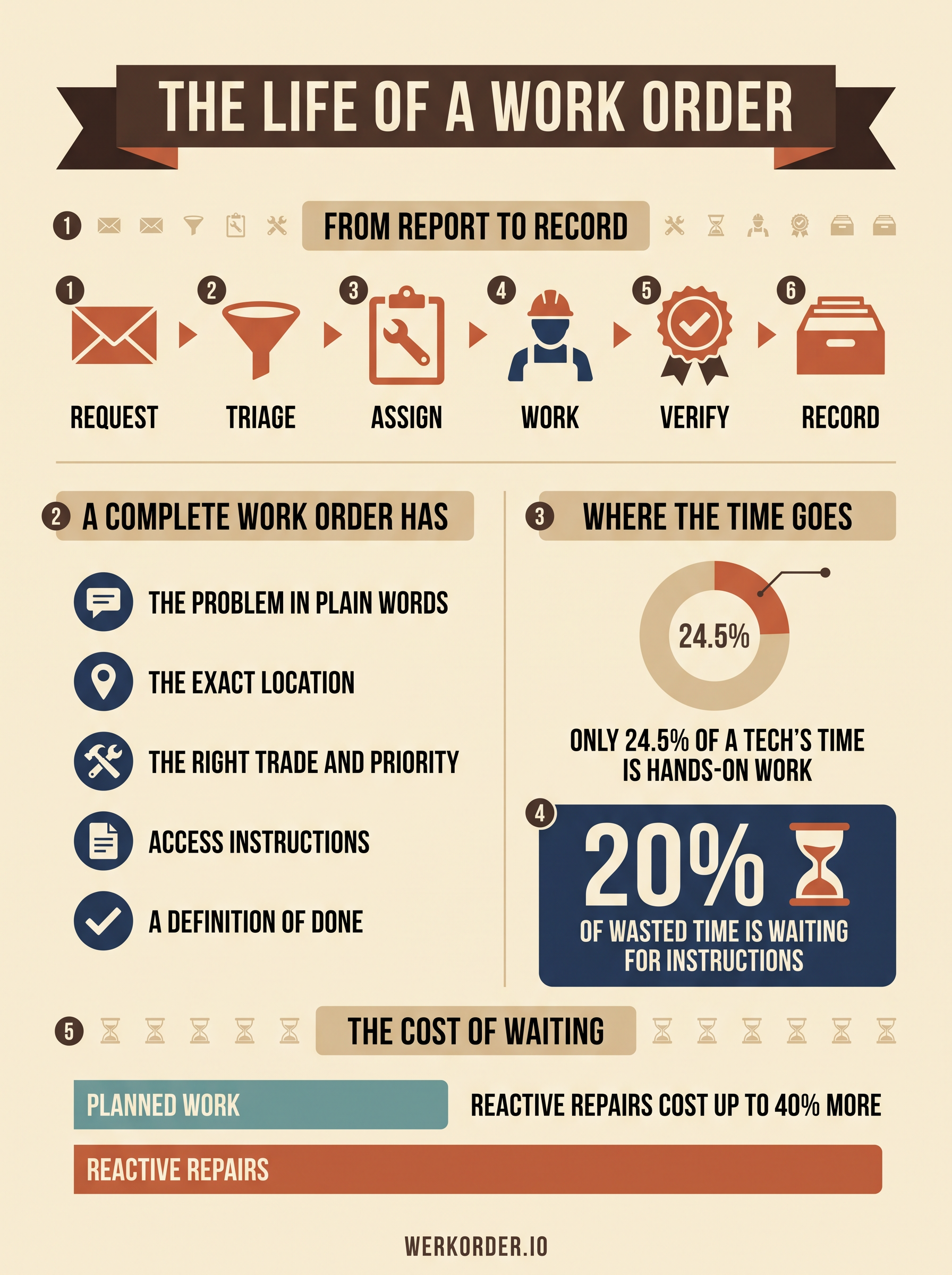
The numbers on untracked work are blunt. The U.S. Department of Energy has found that a predictive approach to maintenance saves "up to 40% over reactive maintenance." Plant Engineering's maintenance survey found that 57% of facilities still run at least some equipment to the point of failure. And a Plant Services study found that only 24.5% of the average maintenance worker's time goes to productive, hands-on work, with nearly 20% of the waste coming from simply waiting for instructions. Bad or missing work orders sit behind all three numbers.
This guide defines the work order properly: what one is, what a complete one contains, how it moves from request to verified completion, and how it differs from the maintenance request and the PM task it is often confused with. Get the work order right and most of what goes wrong in building maintenance gets harder to happen.
A work order, defined
A work order is a documented instruction to perform a specific maintenance task, tied to a specific location, with everything needed to complete the job: what the problem is, where it is, who is responsible, how urgent it is, and how completion will be verified. It is the unit of record for maintenance work, the difference between "someone should fix that" and a task that has an owner, a deadline, and a paper trail.
Two things a work order is not. It is not the request itself: a tenant saying "the bathroom is broken" is raw input, not an instruction anyone can act on. And it is not a to-do list entry: a line on a whiteboard has no location, no history, and no way to prove the work happened when an owner or an inspector asks.
The anatomy of a work order that actually gets done
The gap between a work order that gets closed in two days and one that generates three follow-up phone calls is almost always in the fields. A complete work order carries: a clear description of the problem in plain language, the exact location down to unit and fixture, a priority that reflects real consequences rather than who complained loudest, the assigned person or vendor with the right trade, access instructions so nobody drives out to a locked door, relevant history so the tech knows this is the third time this month, and a definition of done.
That last one matters more than it looks. "Fix the leak" closes when the drip stops. "Repair the leak, identify the source, and photograph the completed work" closes when the problem is actually solved and provable.
The work order lifecycle: request to verified done
Every work order moves through the same six stages, whatever tools you use. A request comes in from a tenant, an inspection, or a schedule. Someone triages it: real or duplicate, emergency or routine, in-house or vendor. It gets assigned to the person or company that will do the work. The work happens. Completion is verified against the definition of done, not just the vendor's word. And the record is kept, because the closed work order is what feeds equipment history, budget decisions, and the answer to an owner's "what did we spend on that rooftop unit this year?"
Most breakdowns happen between stages, not inside them. The request that never became a work order. The completed job nobody verified. The record that lives in a text thread.
Work order vs maintenance request vs PM task
The three get used interchangeably, and the sloppiness costs real money. A maintenance request is the raw report, usually from a tenant, unfiltered and often vague. A work order is the vetted, actionable instruction the request becomes after triage. A preventive maintenance task is a work order that originates from a schedule instead of a complaint: the quarterly belt inspection nobody asked for and everybody needs.
The ratio between them is a health metric. A building generating mostly reactive work orders from requests is running behind its problems. A building where most work orders originate from PM schedules and inspections is running ahead of them.
Where work orders come from
In practice, work orders enter through four doors: tenant reports (email, calls, texts, portal submissions), staff and vendor observations, inspection findings, and preventive maintenance schedules. The doors are the weak point. When requests arrive through five channels and get retyped into whatever system exists, things fall through, and the Plant Services number about waiting for instructions starts showing up in your response times.
The form was never the hard part
Here's the part every property manager already knows in their gut: none of this is complicated. The work order was perfected decades ago. The hard part is follow-through at volume, across a portfolio, forever. Turning every email into a tracked task while the inbox fills up again. Writing complete instructions at 4:45 on a Friday. Chasing verification on the tenth open item of the week. The form is easy. Running the system that keeps a hundred forms honest is the actual job, and it is why untracked work quietly slides toward that run-to-failure statistic.
That's exactly the gap Werkorder was built to close. Its AI turns a tenant email into a structured work order automatically, whether the inbox is connected or the message is simply forwarded in, so requests never wait to be retyped. Auto-dispatch matches the right vendor to the job by trade, location, and availability. The platform builds each building's preventive maintenance and inspection schedule, so PM work orders create themselves on time. And every completed work order rolls up into a Building Health Score, which turns your maintenance history into the owner-ready answer to "how is the building doing?"
Ready to modernize your maintenance?
Join property teams using AI to cut costs and resolve issues faster.